
Typed answers · Spelling · For language learners
Don’t pick the word. Type it.
Choosing from four options trains recognition. Typing trains the thing you need when you speak: pulling the whole word out of memory, spelled right. repeat.cards checks what you typed and shows exactly where it went wrong.
Recognition is not recall
Most flashcard apps show you four translations and ask you to pick one. You can get those right while being unable to say the word yourself — the right option looks familiar, and familiar is enough. Typing removes that crutch. Either the word comes back to you, letter by letter, or it does not, and both outcomes tell the scheduler something true.
It also trains spelling for free. The accents, the double consonants, the silent letters: you cannot type a word without deciding on each of them.
What gets checked
- The word. When a card shows you the translation, you type the word in the language you are learning — with its article, if your deck uses articles.
- The plural and the verb forms. If the card has them, there is a box for each, and each is marked on its own.
- Answers you have accepted. A card can hold alternative answers, and any of them counts as right.
Before comparing, case, punctuation and repeated spaces are set aside. Letters are not — in any script — so an accent you left off is a spelling mistake, not noise.
What counts, and what the diff shows
The card asks for the Spanish word for is (as in “where is it?”). The answer on the card is está.
está
- Marked
- Right
- What the diff shows
- The word, all matching
Está.
- Marked
- Right
- What the diff shows
- Case and the full stop are ignored
esta
- Marked
- Wrong
- What the diff shows
- The a, with the accent it needed
estar
- Marked
- Wrong
- What the diff shows
- The extra r, struck through
es
- Marked
- Wrong
- What the diff shows
- The missing letters, underlined in place
The diff works letter by letter: extra letters are struck through, missing ones are shown where they belong, a wrong letter shows both, and a wrong or missing accent is marked on the letter it belongs to. The correction is exactly as big as the mistake.
When your answer is right but different
Languages have synonyms, and a card can only list the answers someone thought of. If what you typed does not match, press Check my answer: AI looks at the card and your answer and tells you whether it is also correct, with a short explanation either way. When it is, one more tap adds it to the card’s accepted answers, so the next time it simply counts.
Then the schedule takes over
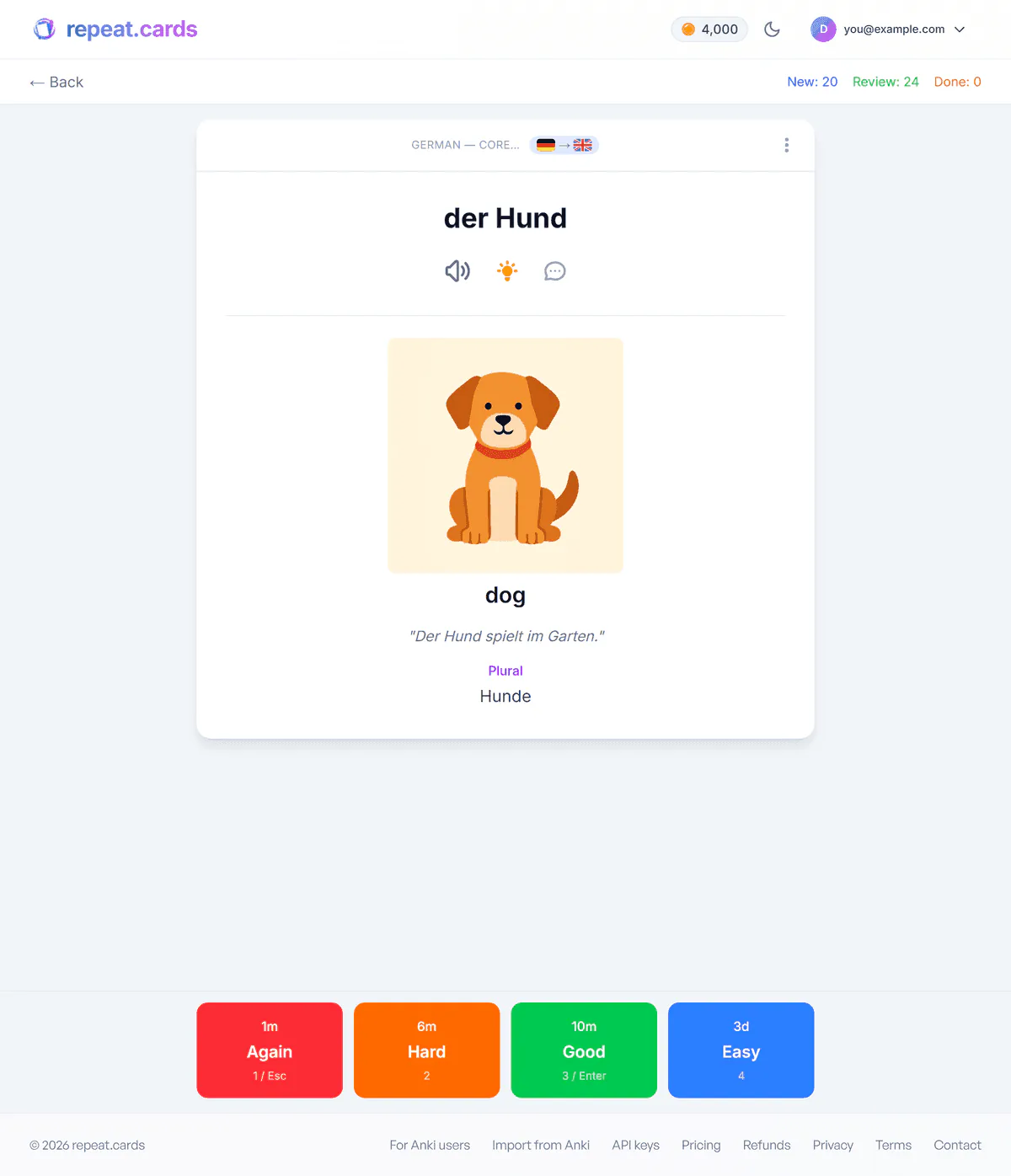
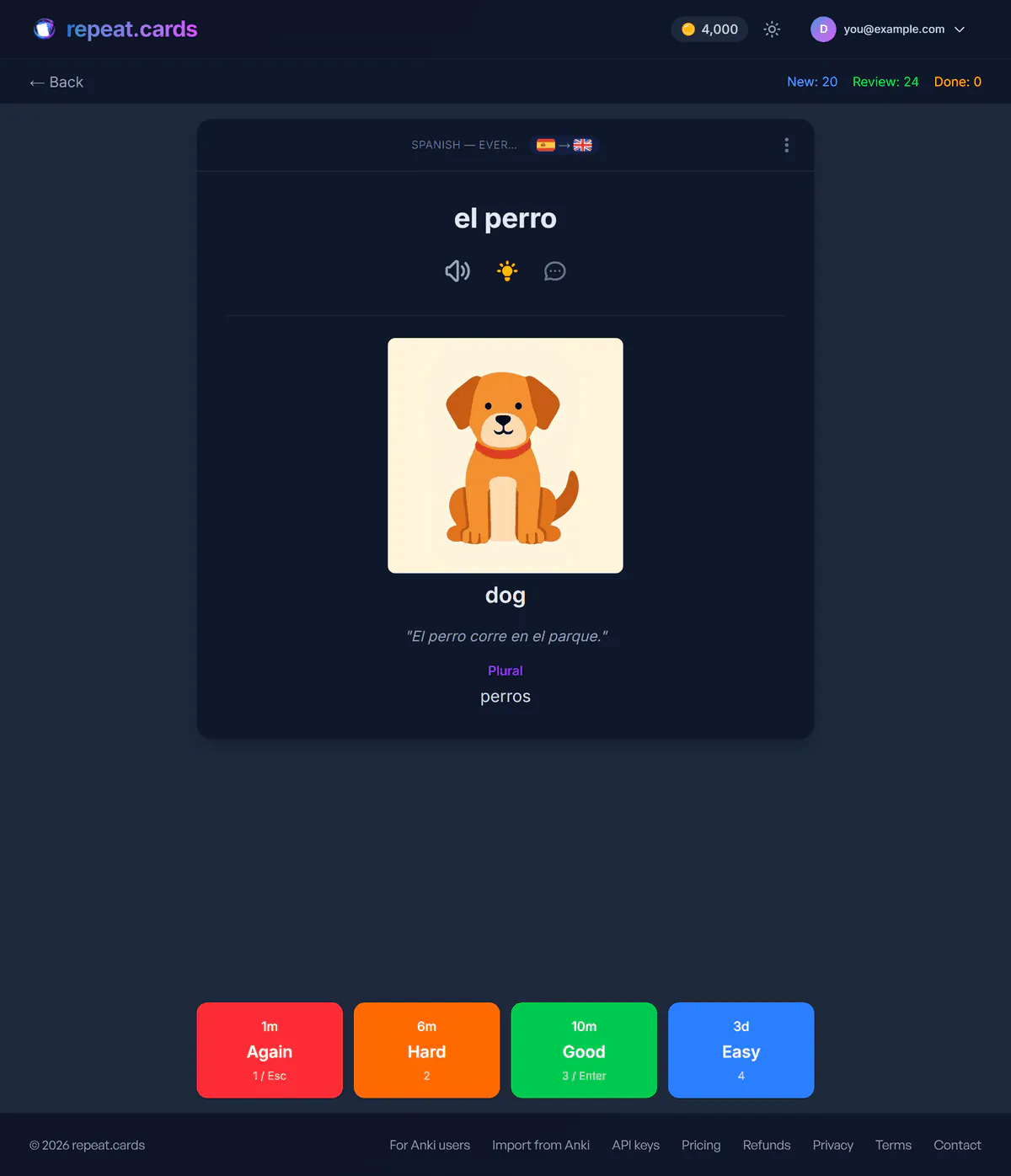
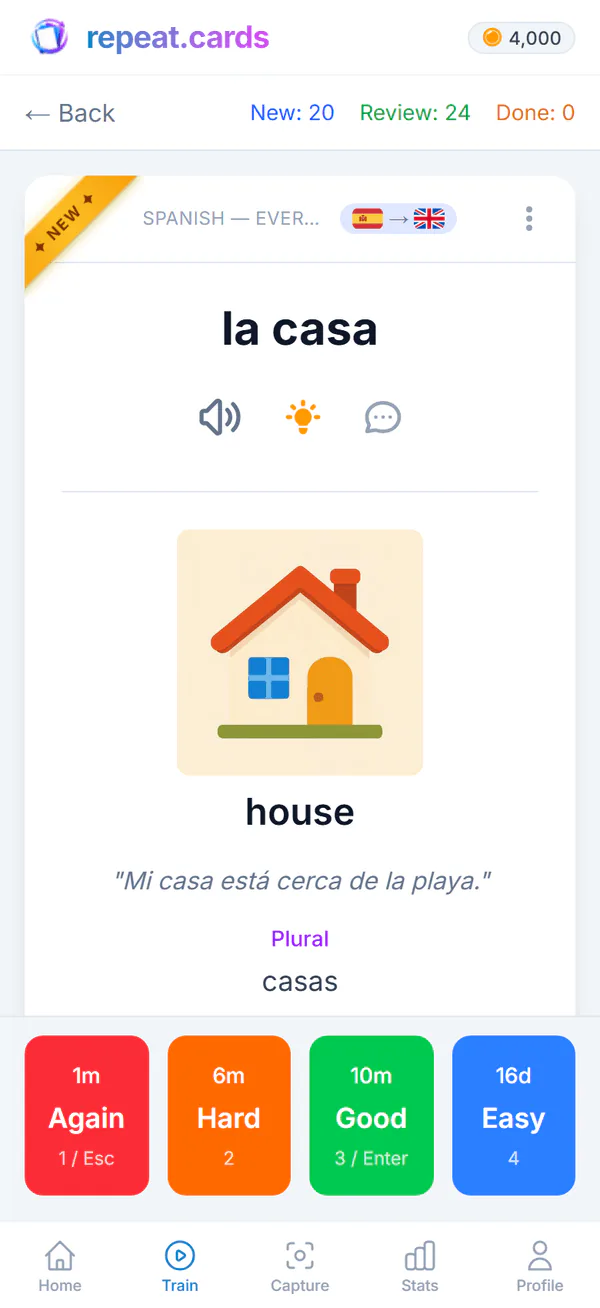
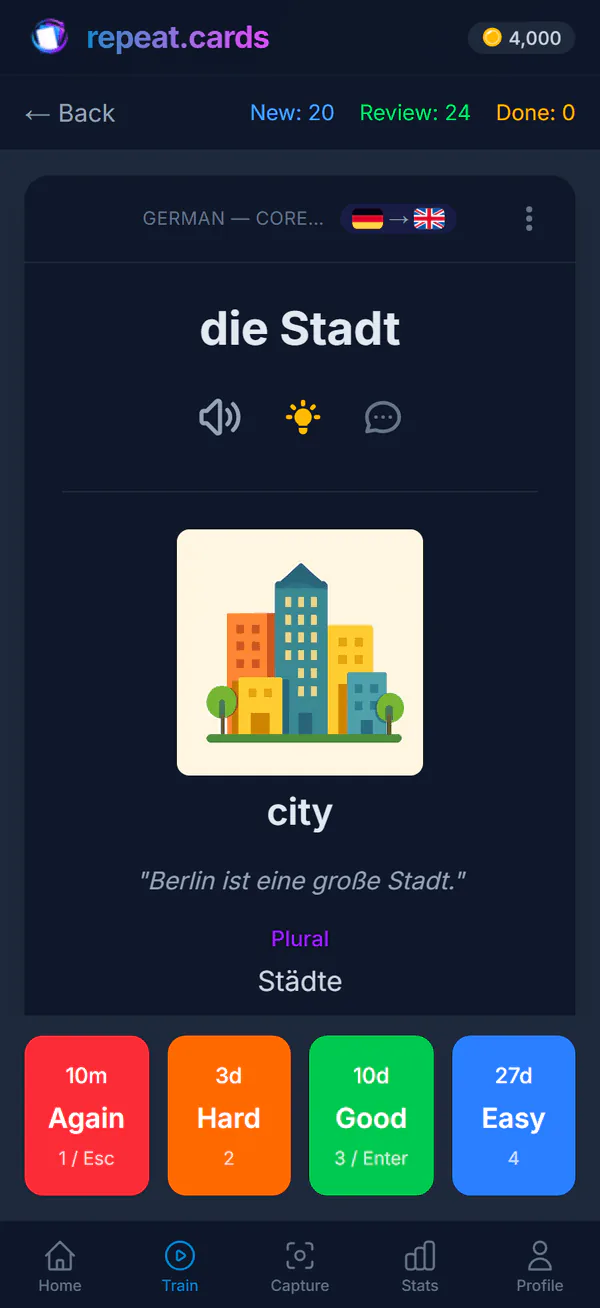
After the answer is checked you rate how hard the card felt, and FSRS spaced repetition schedules it for the moment you are about to forget it. The two directions of a card are scheduled separately: typing está from is and understanding está when you see it are different skills, and each gets its own timing. In the direction that shows you the word, you recall its meaning, turn the card and rate yourself.
Typed answers FAQ
Why type the answer instead of choosing it?
Does a capital letter or a full stop make my answer wrong?
What if I typed a synonym?
Do I type the answer in both directions?
Does it work for languages that do not use the Latin alphabet?
Type it until you know it.
Add the words you are learning and start typing them back. Free to start, no credit card.
Get started — freeTyped answers · Letter-by-letter diff · Every script
Keep reading
Grammar flashcards
Articles, plurals and verb conjugations on every card, preset for seven languages and checked in training.
Spaced repetition
FSRS schedules each word for the moment you would forget it, with the two directions of every card scheduled separately.
Ask about a word
Three memory hooks to choose from, and a chat on every card about grammar, usage and look-alikes.
Pricing
What coins are, what packs cost, and what stays free.