
Comparison · Flashcard apps · For language learners
The best flashcard app for languages depends on your words.
Ready-made decks, a course, or your own vocabulary: each points to a different app. Here is what five of them do, including where we are not the right pick.
Build your own vocabulary deck
What to look for in a flashcard app for languages
Vocabulary is harder than most flashcard subjects. A word comes with a gender, a plural, verb forms, a pronunciation, and two directions to learn — recognising it and producing it. So the questions worth asking are: where do the words come from, who makes the card, does the app know the grammar of the language, and how does it decide when you review.
- Where the words come from. Shared decks, a course, or the words you meet yourself.
- Who makes the card. You by hand, add-ons, or AI built into the app.
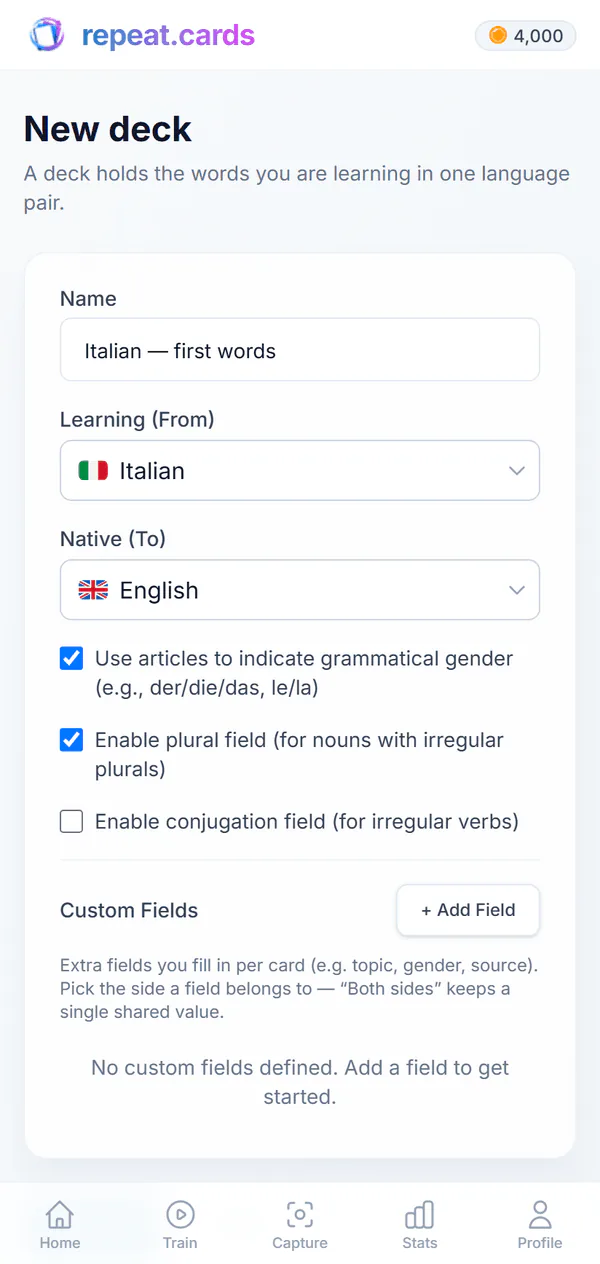
- Grammar. Whether articles, plurals and conjugations are part of the card or left to you.
- Scheduling. FSRS is the modern standard; some apps use simpler systems such as Leitner boxes.
- Platforms and price. Where you can study, and what the free plan really includes.
Five apps compared
Details for the other apps were read on 5 September 2026 from each vendor’s own site or store listing, or from two independent secondary sources where a price is not published. A dash means we did not verify it.
Who picks the words
- repeat.cards
- You
- Anki
- You, or shared decks
- Quizlet
- You, or shared sets
- WordPlus
- You, from your translations
- Memrise
- The course
Platforms
- repeat.cards
- Web, plus a free Android app
- Anki
- Desktop, web, Android, iOS (paid)
- Quizlet
- Web, iOS, Android
- WordPlus
- iOS, Android
- Memrise
- —
Scheduling
- repeat.cards
- FSRS, each direction separately
- Anki
- FSRS; reverse direction via a note type you set up
- Quizlet
- Its own system
- WordPlus
- Leitner
- Memrise
- —
AI builds the card
- repeat.cards
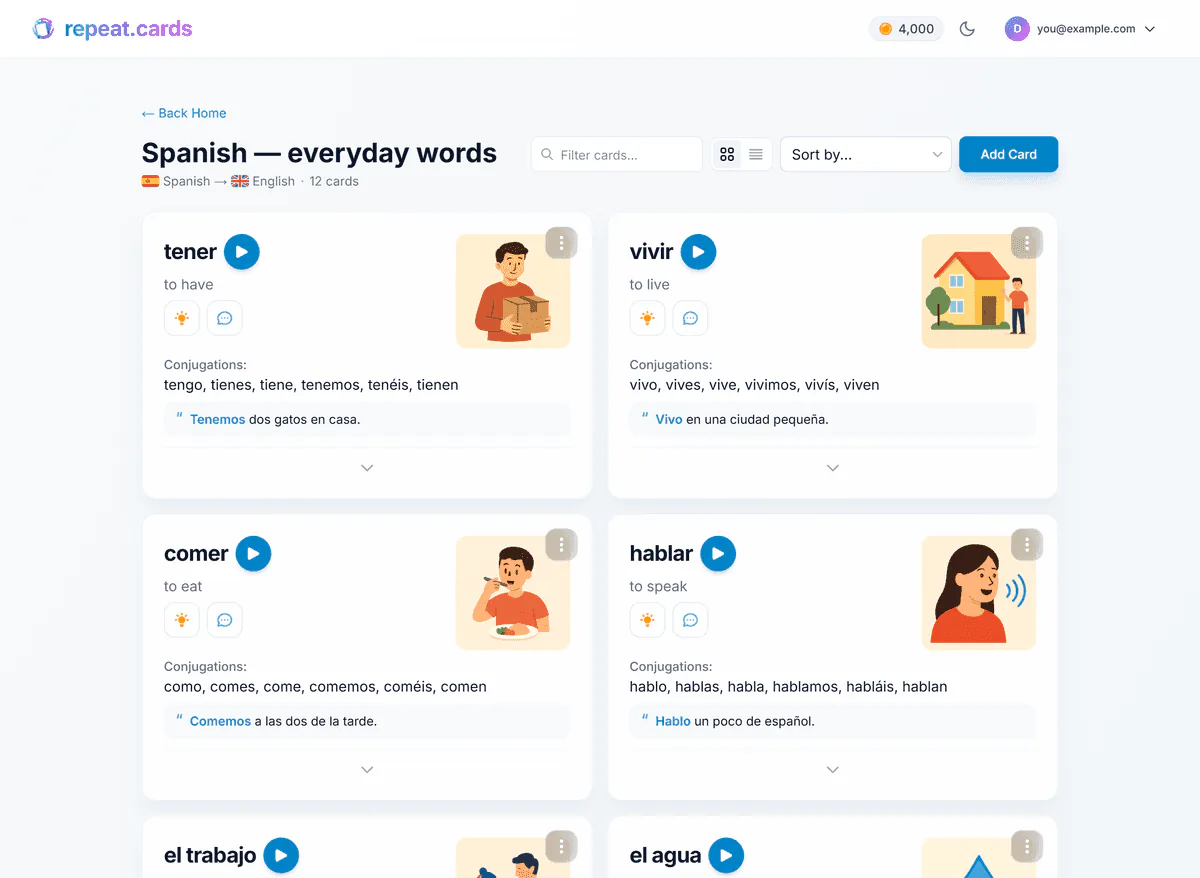
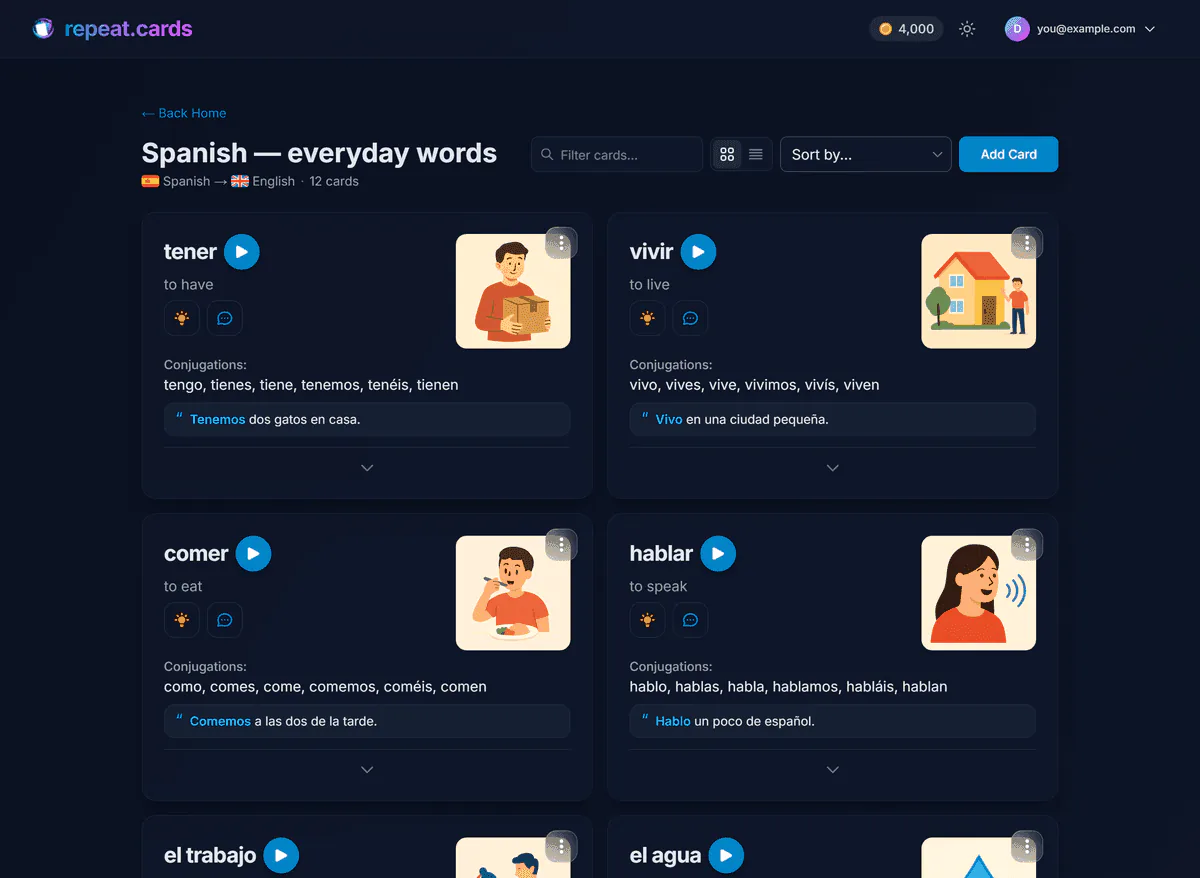
- Translation, example, audio, mnemonic, picture, grammar
- Anki
- Not built in
- Quizlet
- Some tools, mostly on Plus
- WordPlus
- AI translation and set generator (Premium)
- Memrise
- —
Articles, plurals, conjugations
- repeat.cards
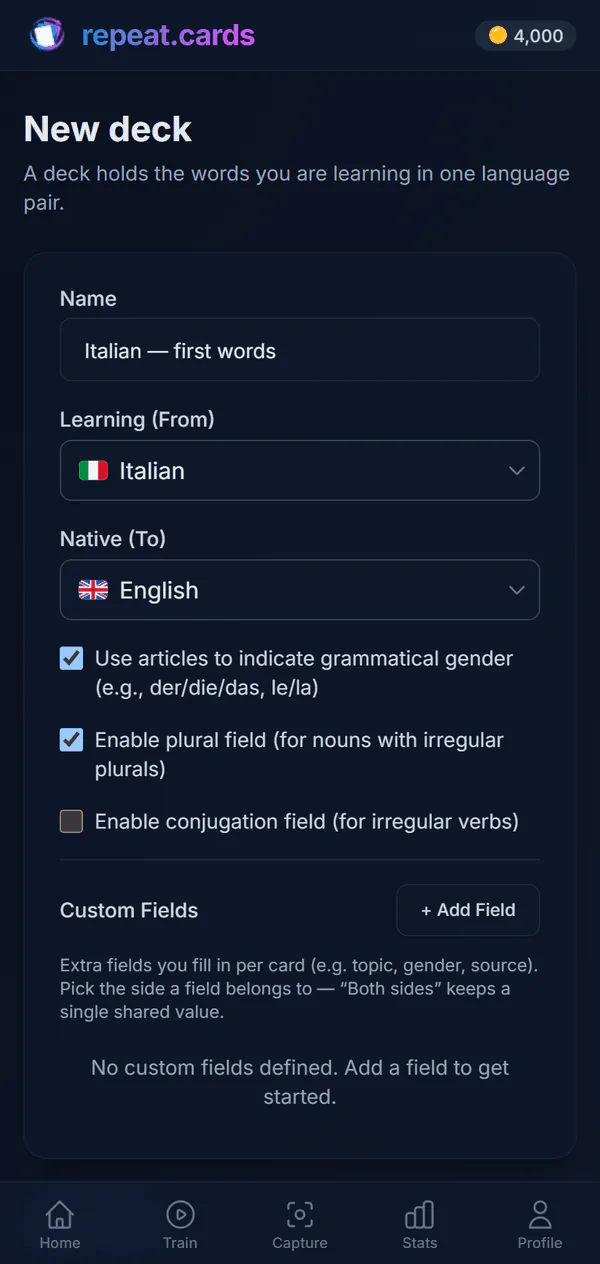
- On the card, preset for 7 languages
- Anki
- Build your own
- Quizlet
- No
- WordPlus
- Partly
- Memrise
- —
Ready-made decks
- repeat.cards
- No
- Anki
- Huge shared library
- Quizlet
- Huge library
- WordPlus
- Partly
- Memrise
- Courses
iPhone app
- repeat.cards
- No
- Anki
- Yes, $24.99 one-off
- Quizlet
- Yes
- WordPlus
- Yes
- Memrise
- —
Price
- repeat.cards
- Core free; AI on coins
- Anki
- Free; iOS app paid
- Quizlet
- Free with daily caps; Plus $35.99/yr
- WordPlus
- Premium $79.99/yr
- Memrise
- Limited free; Pro from $7.50/mo
When each one is the right pick
Anki if you want a free tool and are happy to set it up: a huge library of shared decks, FSRS, and a desktop app that works offline. Quizlet if you want ready-made sets and can live with the free plan’s caps. WordPlus if you want your own words on an iPhone and do not mind a subscription. Memrise, or any course app, if you want the words chosen for you in order.
repeat.cards if you are building your own vocabulary and want the card made for you: the example, the pronunciation, a mnemonic, a picture, the article and the verb forms, on a schedule that treats the two directions of every word separately.
Why the two directions matter
Recognising a word when you read it and producing it when you need it are different skills, and they fade at different speeds. None of the other apps we checked keeps them apart by default, so the easy direction pulls the hard one along with it. repeat.cards keeps a separate FSRS schedule for each direction of every card, with nothing to set up: the word you can read but not yet say keeps coming back until you can.
Where repeat.cards is not the right pick
It has no library of ready-made decks: every card starts from a word you add. There is no iPhone app today; it runs in the browser and on Android. And it is built for languages only — for medicine, law or history, a general flashcard app will serve you better.
Flashcard apps FAQ
Which flashcard app is best for learning a language?
Is Anki still worth it for languages?
Is Quizlet still free?
Does repeat.cards have ready-made decks?
Which app schedules reviews best?
Your words, made into cards.
Pick the language you are learning and add your first words. Free to start, no credit card.
Get started — freeFSRS in both directions · Grammar on the card · 100+ languages
Keep reading
Vocabulary app
Add the words you meet at any level; AI fills in each card and spaced repetition keeps them.
Use with Duolingo
Keep Duolingo for the course and use repeat.cards to keep the words you meet in it.
Spaced repetition
FSRS schedules each word for the moment you would forget it, with the two directions of every card scheduled separately.
Pricing
What coins are, what packs cost, and what stays free.