
Grammar flashcards · Articles, plurals, conjugations
Learn the word with the grammar that comes with it.
The article that tells you the gender, the plural you cannot guess, the verb forms you will actually need. Switch them on for a deck, and every card carries them — filled in by AI, asked for in training.
Why a translation is not enough
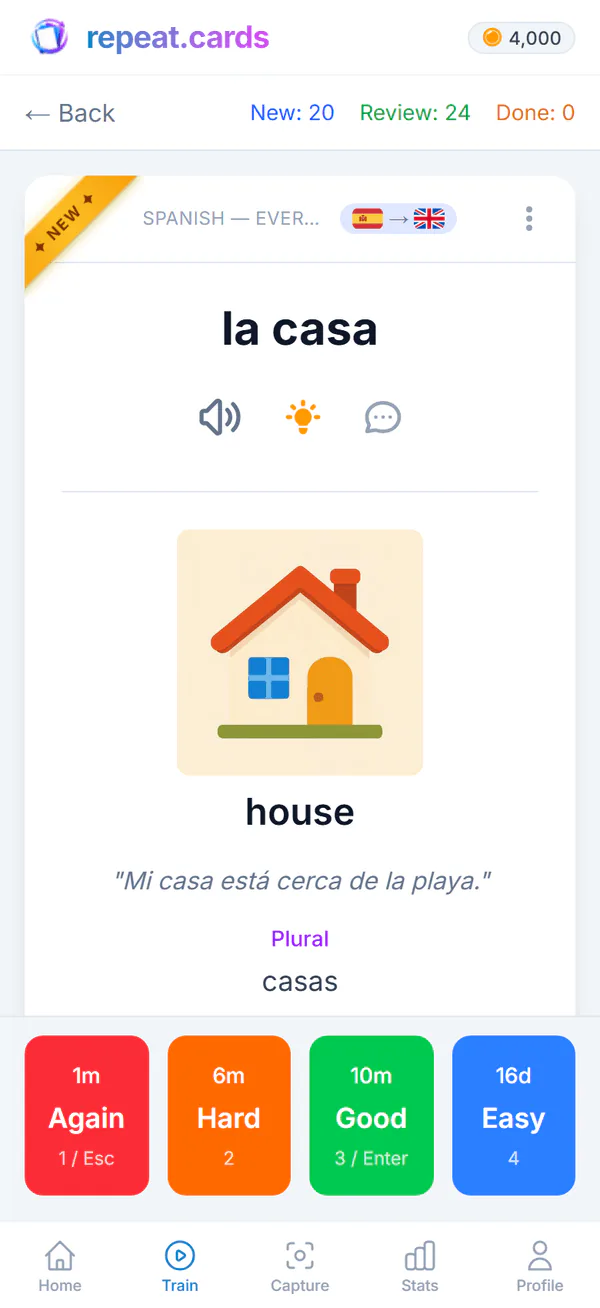
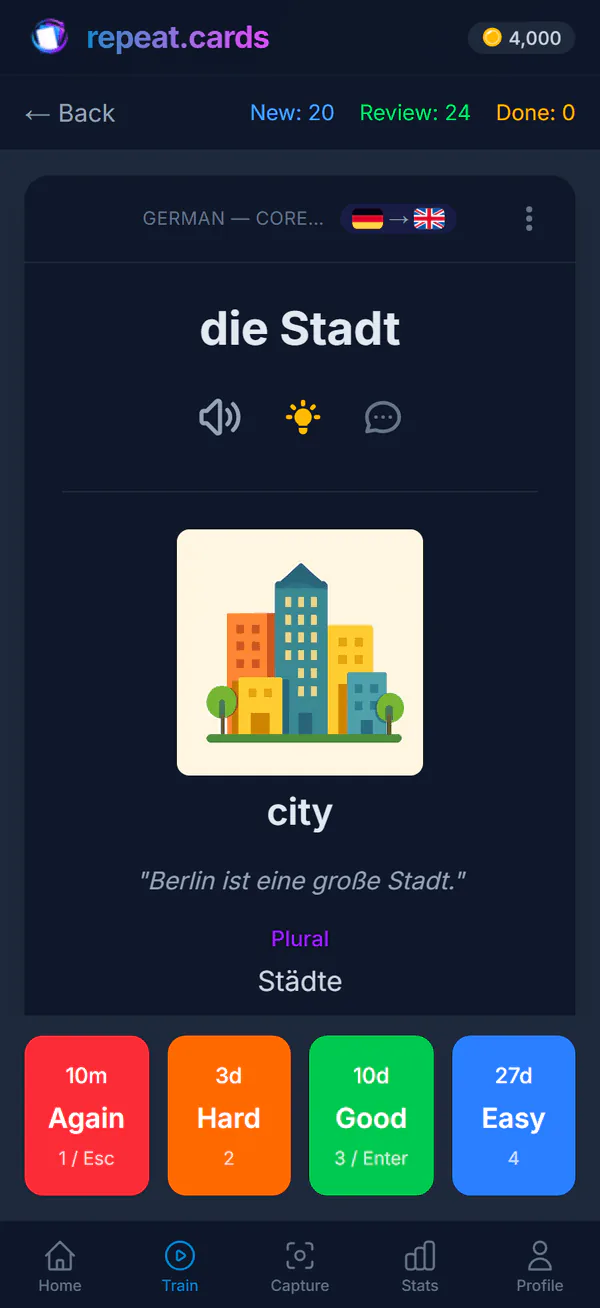
Knowing that Stadt means city does not tell you it is die Stadt, or that two of them are die Städte. Knowing that tener means to have does not get you to tengo. Those are exactly the parts that go wrong when you speak, and they are the parts a plain word-and-translation card leaves out.
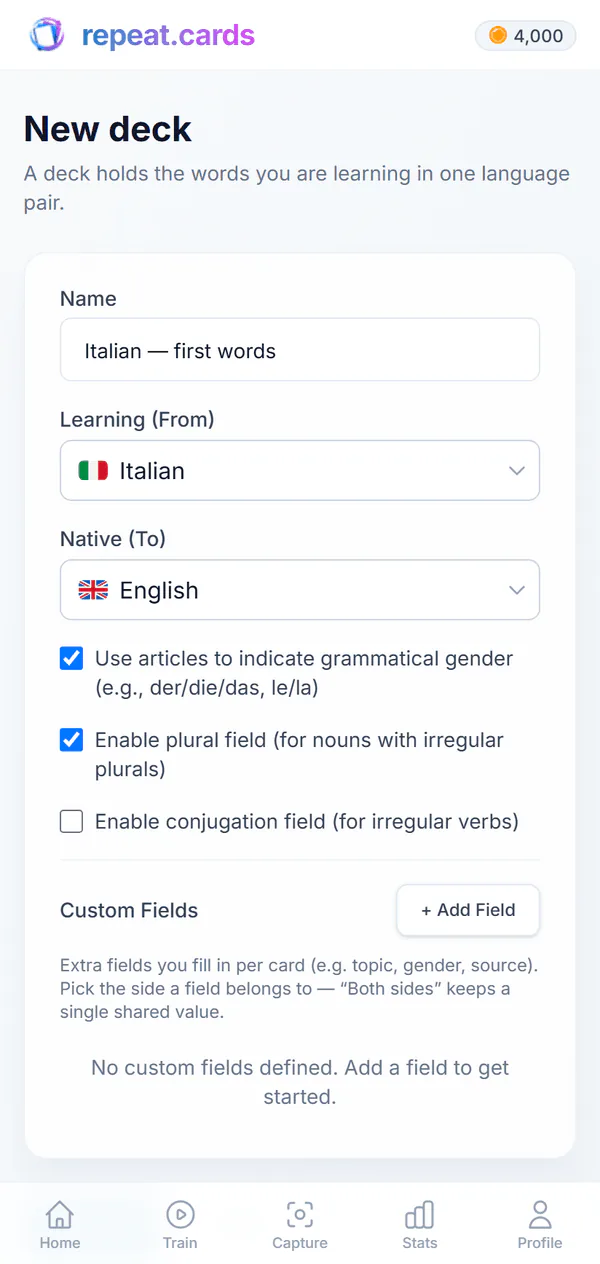
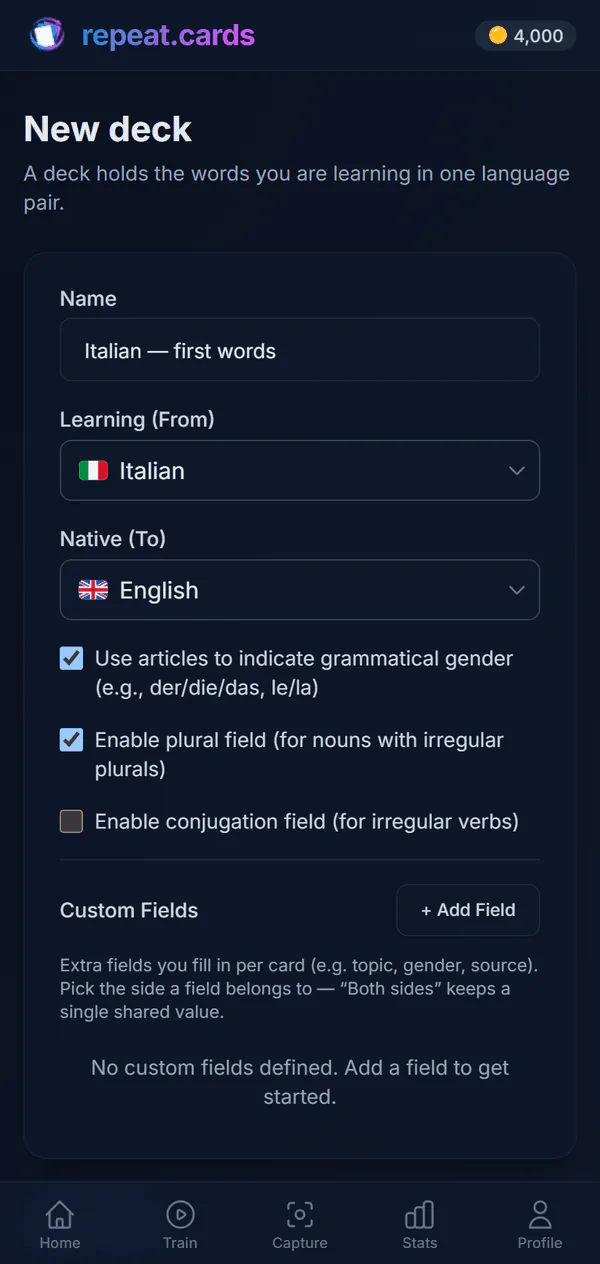
In repeat.cards the grammar is part of the card. You decide once, per deck, which parts your language needs; after that every card in the deck has room for them, and training checks them.
Three switches per deck
- Articles. The article becomes part of the word, so the gender is learned with it — der/die/das, le/la, o/a. When a deck uses articles, the AI word check adds one to a noun you typed without it.
- Plurals. A plural field on every card, for nouns whose plural you cannot work out from the singular.
- Conjugations. One field per verb form. Switching it on fills in the preset for the language you are learning; you can add, rename or remove fields.
When you create your first deck while setting up your account, these switches are set for you from the language you choose: a language without articles gets no article switch, one whose verbs do not conjugate gets no conjugation fields.
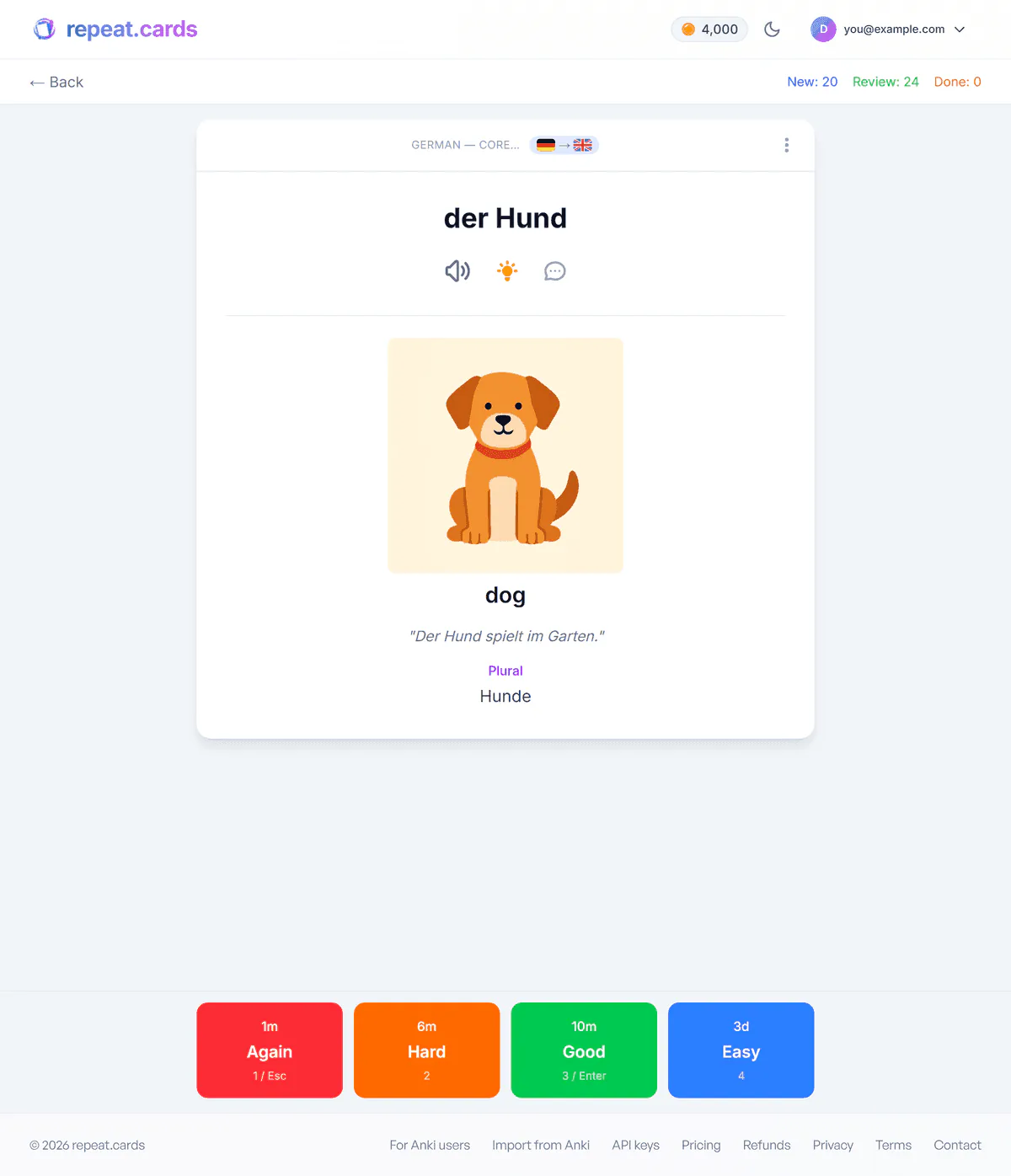
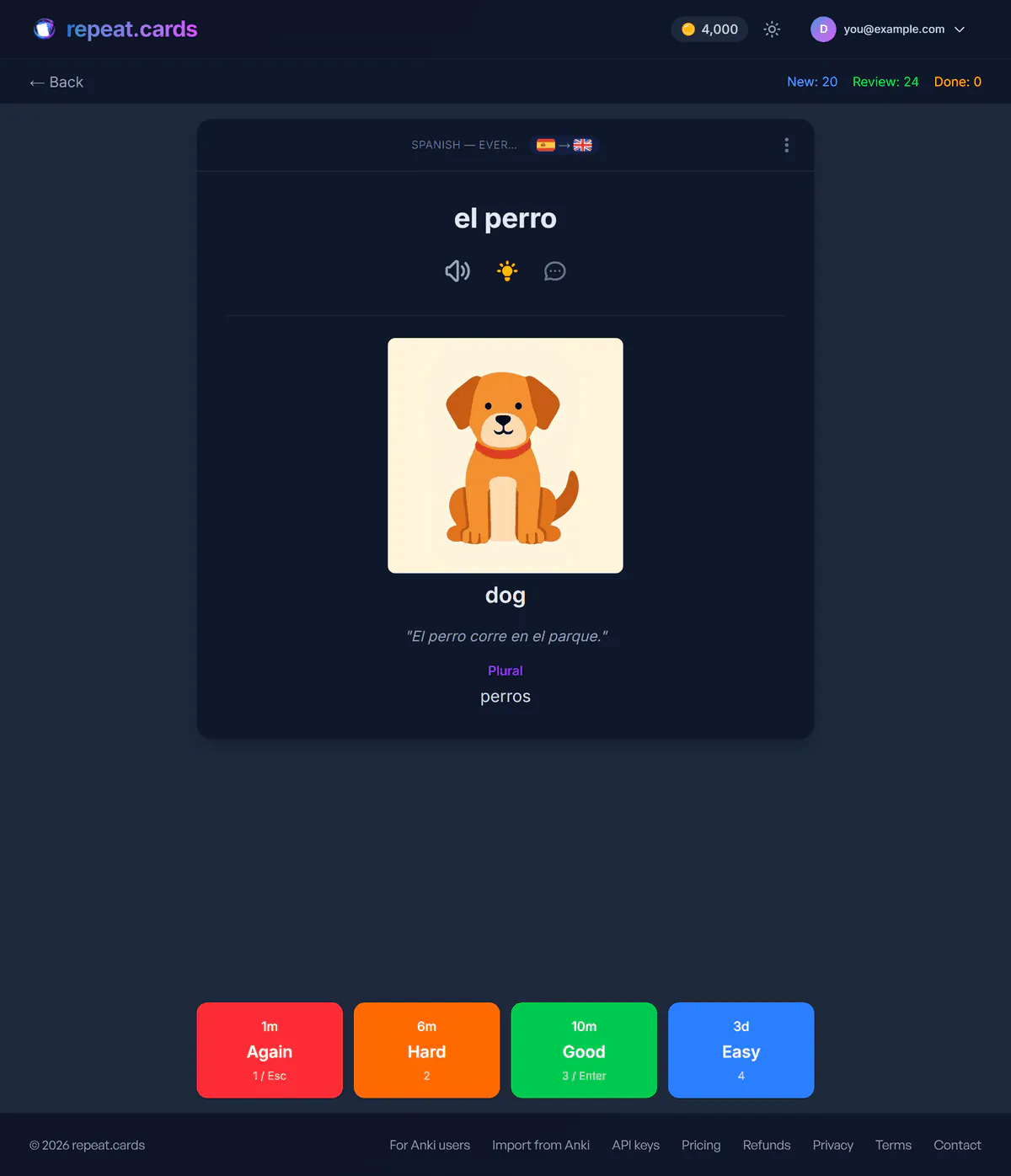
Two cards, fully filled in
A German noun in a deck with articles and plurals switched on, and a Spanish verb in a deck with conjugations. Everything on the right can be written by AI and corrected by you.
Word
- German noun
- die Stadt
- Spanish verb
- tener
Translation
- German noun
- city
- Spanish verb
- to have
Plural
- German noun
- die Städte
- Spanish verb
- —
yo / ich
- German noun
- —
- Spanish verb
- tengo
tú / du
- German noun
- —
- Spanish verb
- tienes
él / er
- German noun
- —
- Spanish verb
- tiene
nosotros / wir
- German noun
- —
- Spanish verb
- tenemos
vosotros / ihr
- German noun
- —
- Spanish verb
- tenéis
ellos / sie
- German noun
- —
- Spanish verb
- tienen
The presets, and everything else
The conjugation presets are the six persons for Spanish, German, French, Portuguese, Italian and Russian, and for English the base form, the third person, the past tense, the past participle and the -ing form. They are a starting point, not a cage: if your course drills the preterite, add a field for it.
For anything the three switches do not cover there are custom fields. Give one a name, choose whether it belongs on the front, the back or both sides of the card, whether it is shown during training, and whether it takes one value or several. Russian verb aspect partners, Polish cases, Chinese measure words — the deck gets whatever shape your language needs.
The grammar is trained, not just stored
When a card shows you the translation, you type the answer: the word, and below it the plural and each verb form the card has. Every box is checked on its own, so getting the word right and the plural wrong tells you precisely what to review. Spaced repetition then schedules the card for the moment you are about to forget it.
Grammar flashcards FAQ
Can I make flashcards that show the gender of a noun?
Which languages have conjugation presets?
Do I have to fill in the plurals and verb forms by hand?
What if my language needs a field that is not there?
Are the grammar fields checked in training?
Remember the word, and how it bends.
Pick the language you are learning; the grammar fields that fit it are switched on for you. Free to start, no credit card.
Get started — freeArticles · Plurals · Conjugations · Custom fields
Keep reading
Typed answers
Type the word instead of picking it; a letter-by-letter diff shows exactly what was off.
AI flashcards
Type a word and AI fills in the rest of the card: example, audio, mnemonic, picture, grammar.
Spaced repetition
FSRS schedules each word for the moment you would forget it, with the two directions of every card scheduled separately.
Pricing
What coins are, what packs cost, and what stays free.